Beyond the Penetration Test: What is a Red Team Engagement and Why Do You Need It?

In the world of cybersecurity, terminology gets thrown around loosely. You hear about "scanning," "hacking," and "testing," often used interchangeably. But if you are serious about organizational security, there is a hierarchy of testing, and sitting at the very top is the Red Team Engagement.
If you’ve ever watched a spy movie where an elite team breaks into a high-security vault using disguise, technical gadgetry, and sheer audacity, you already have a basic grasp of red teaming.
But how does that translate to corporate information security? What exactly is a red team engagement, who is it for, and crucially, how is it different from the penetration testing you might already be doing?
Here is a breakdown of the ultimate security stress test.
What is a Red Team Engagement?
The term "Red Team" originated in the military during the Cold War. The United States needed a way to test its strategies and defenses from the enemy's perspective (the Soviet Union, often denoted by the color red). They created teams whose sole job was to think and act like the adversary.
In cybersecurity, a Red Team Engagement is a comprehensive, multi-layered adversarial simulation designed to assess an organization's ability to withstand a real-life adversary's attack on its people, networks, applications, and physical security controls.
Unlike standard security testing, which looks for lists of technical flaws, a Red Team has a specific objective. For example: "Gain access to the CEO’s email account," or "Exfiltrate sensitive customer database records without being detected."
The Red Team doesn't just attack your technology. They attack your organization holistically. They might send phishing emails to employees, try to tailgate into your office building, drop infected USB drives in the parking lot, and hack your external firewall simultaneously.
What is it for? (The Purpose)
If you already do vulnerability scanning, why do you need this?
The primary purpose of a Red Team engagement is not just to find vulnerabilities. The primary purpose is to test your organization’s detection and response capabilities.
You have a security team (your "Blue Team"), firewalls, antivirus, and monitoring tools. A Red Team engagement answers the terrifying question: If a sophisticated attacker targeted us tomorrow, would we even notice? And if we did notice, could we stop them in time?
It is designed to:
Identify Blind Spots: Uncover complex attack paths that automated tools and standard tests miss.
Test Human Behavior: See how easily employees fall for social engineering or physical breaches.
Stress-Test the Blue Team: Measure how long it takes your defenders to detect an active intruder and how effective their incident response plan is under pressure.
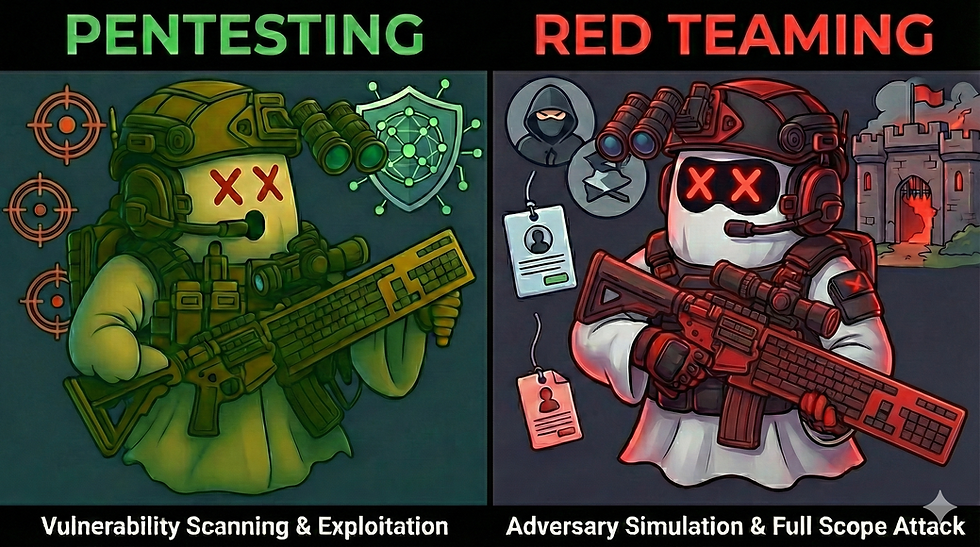
The Crucial Difference: Red Teaming vs. Penetration Testing vs. Vulnerability Scanning
This is where most confusion lies. It helps to think of security testing as a ladder of maturity.
1. Vulnerability Scanning (The Baseline)
This is automated. You run a piece of software that scans your network against a database of known flaws (like missing patches).
Goal: Find the low-hanging fruit.
Analogy: Walking around your house, checking if the windows are closed and the doors are locked.
2. Penetration Testing (The Technical Deep Dive)
This is a human-led, targeted assessment of a specific scope (e.g., "test our new mobile app" or "test our external network IP addresses"). The goal is to find as many vulnerabilities as possible within that scope to prove they can be exploited. They usually aren't trying to be stealthy.
Goal: Find all technical flaws in a specific system.
Analogy: Hiring a locksmith to see how many different ways they can pick the locks on your front door.
3. Red Team Engagement (The Real-World Simulation)
This is objective-based and stealthy. The scope is usually "anything is fair game" (within legal limits). They will use any means necessary—technical or social—to achieve their goal, trying desperately not to get caught by your security team.
Goal: Test the organization's entire defense capability against a focused objective.
Analogy: Hiring a team of professional thieves to try and steal the jewelry hidden in your safe without tripping the alarm or waking up the guard dog.
Here is a quick comparison view:
Feature | Penetration Test | Red Team Engagement |
Primary Goal | Find technical vulnerabilities. | Achieve a specific business objective (e.g., data theft). |
Scope | Narrowly defined (e.g., one application). | Broad / Open Scope (People, Process, Tech). |
Stealth | Low. They want to find issues fast. | High. They want to evade detection. |
Duration | Days to weeks. | Weeks to months. |
Tests Response? | Usually no. | Yes, this is critical. |
Who Needs a Red Team Engagement?
Red teaming is not for everyone. It is an advanced security exercise.
If your organization is still struggling with basic hygiene—like patching software on time, using multi-factor authentication (MFA), or running regular backups—a Red Team engagement is a waste of money. The Red Team will decimate you in hours, and you won't learn anything you didn't already know.
You need a Red Team engagement if:
You have a mature security program: You already do regular vulnerability scanning and penetration testing and have remediated the most common issues.
You have a dedicated internal security team (Blue Team): You need someone to monitor, or there is nobody to test against.
You handle high-value assets: You are in finance, healthcare, critical infrastructure, or hold sensitive intellectual property that sophisticated attackers want.
You need a reality check: Leadership believes the company is "secure," and you need irrefutable proof of actual risk exposure.
The Takeaway
A Penetration Test tells you if your systems can be broken into. A Red Team engagement tells you if your organization can be beaten.
In an era where advanced persistent threats are the norm, relying solely on technical audits isn't enough. Sometimes, the only way to know if your defenses truly work is to hire the "bad guys" to test them for you.